An independent testing laboratory, built on measurement.
Since 1981, Roof Leak Detection Company, Inc. has served South Florida as a certified testing laboratory and consulting firm for commercial and industrial flat roofs — positioning itself as America’s leading and most trusted consulting firm in the field.
Testing and consulting — not sales
We specialize in testing and consulting services for commercial and industrial properties with flat roofs, including but not limited to condominiums, shopping plazas, hotels, and professional parks. We are dedicated to the task of reducing roof maintenance costs through our comprehensive testing services.
On every engagement, our company prepares a detailed written report with findings and recommendations regarding the condition of the roofing system — including a color graph outlining problem areas, if any. Because we are independent, our recommendations answer to the building owner and the evidence, not to a roofing contractor’s quota.
What our engineering evaluates
A roof system must resist wind uplift across every component — substrate, membrane, flashing, metal coverings, and penetrations.
The most important reason for proper attachment is to prevent damage from wind force, particularly wind uplift. Wind damage occurs primarily at perimeters and corners and infiltrates the entire system. Generally, wind vortexes occur at the perimeter of the building, displacing perimeter components — flashings, fasteners, and metal coverings — and creating openings for wind entry. The wind then moves through the system in a cross-directional pattern, creating uplift and damage at points throughout the assembly.
Wind uplift can also occur from below the deck in facilities damaged by wind entering through interior openings such as windows, doors, and overhead doors. Secondary wind damage can occur at the roof from membrane protrusions created by wind-driven projectiles.
To determine the structural integrity and resistance to the forces of wind uplift, Roof Leak Detection employs 5×5 Bell Chamber testing under Testing Application Standard (TAS) 124-95, performed in conjunction with Irving Abcug, P.E., a Florida-registered and licensed engineer. The calculated pressure applies to the entire roof system — deck and all above-grade components — though this procedure determines attachment rates for the field of the roof; pressures required for corners and perimeters are calculated separately.
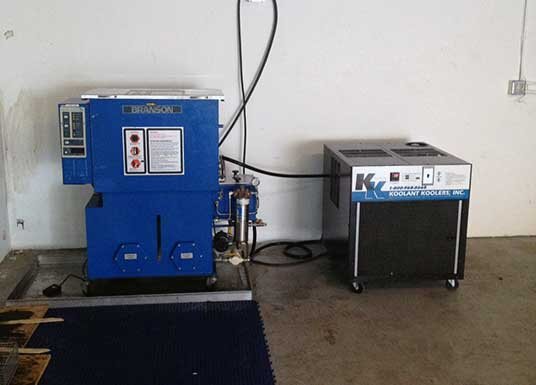
Pictured: de-saturation testing equipment used to evaluate the degree of moisture saturation in roof components.
Have a roof you can’t read?
We’ll bring the instruments and the report. You get the facts.